Ben Kestner
Thoughts on Education
Creating the Best Conditions for Growing. A Message for Educators

WESTERN MONTANA GROWERS COOPERATIVE
Farmers need to think carefully about the conditions for growing if their crops are to flourish.
Places for learning need to think carefully about the conditions for learning if their students are to flourish.
I say ‘places for learning’ over ‘schools’ and ‘learning institutions’ or even ‘places of learning’ because we need to rethink and challenge norms and pre-existing assumptions if we are to try to address the needs of our students right now today. The currency we are going to give our students today to interact with a fast changing world is very different from the currency we gave our students before.
I’ve been lucky enough to spend time over the last six summers or so on my sister-in-laws’ farm. A beautiful setting with wonderful organic produce.
Visiting a farm at one of the busiest times of the year requires the visitor to help, and so I have been involved as a worker, getting invloved where I can. Whilst farming is by no means an area of expertise I can boast, I do know that the right conditions are crucial for the produce to flourish. A careful balance of knowledge, experience as well as a reliance on weather conditions, water sun etc.
Education is no different. We need to create the best conditions for learners to flourish. A place where they can grow. The teacher is the farmer with a huge responsibility.
When I walk in and out of classrooms at school, I look carefully at the conditions for learning. Not only the physical space (the land) but the nurturing and coaching of the teacher (maintaining and utilizing the weather conditions) as well as the resources available (the tools).
I think kids flourish in learning environments which:
- support innovative thought
- encourage questioning and critical thinking
- encourage discovery
- offer space to grow as a learner with unique styles and needs
- are fun
So, lets get out there with our wellies on, equipped with the tools and start growing!
The Real Goals of Education
We are part of an increasingly globally-connected and knowledge-based world and educators have the responsibility of continuing to prepare students for what is around them and what they will experience when they leave school. Our task is not easy. We do not really know how the world will look in five, ten, or twenty years’ time. So preparing them for what we don’t know seems impossible.
But even though we are witnessing mind-boggling advances in technology in many aspects of life, the real goals of education have not changed. It is important that our children continue to love learning new things throughout their lives. We want to nurture confident and healthy students, physically, mentally and emotionally, who understand their own bodies and ways of thinking. We want to encourage caring and compassionate students who will make a contribution to the well-being of the world around them.
Currently in the Middle School I am at, we are examining our curriculum framework and pedagogical practices to make sure that we are providing the best possible opportunities for our students. A quality curriculum and quality teaching go hand in hand as we go forward.
Skills and concepts that are vitally important for our students in this fast-changing world include collaboration, communication, global thinking, critical thinking and information technology literacy, which need to be fostered in a creative and innovative environment. Humans have a wide range of cognitive abilities and so we must offer a balanced curriculum, giving opportunities for our students to explore and experience in a number of settings.
The role of a teacher is that of a coach. In this age of instant information, teachers can no longer think of themselves as the giver of knowledge (I would argue that they should never have thought this), which is eaten and then regurgitated by the students. Teachers need to support, encourage and nurture a talent or interest and help students to learn independently. By establishing an exciting and welcoming learning environment, we as educators invite students to take an active role in the learning process, as they use tools provided to enhance and promote their own enrichment. This, in turn, builds the foundation of the entire community, as every individual student engages in learning as a celebratory and empowering enterprise.
At St. John’s International School, Belgium, we have made huge advances in providing our students with these tools. We have a new data management system, full Wi-Fi throughout the school, one-to-one netbooks being rolled out in four grades this year, a new virtual learning environment for students (Study wiz) and a strong commitment to investing in technology and professional development for staff.
But we also have a strong commitment to what we see as the real goals of education: helping students to be themselves and helping them to understand that they have choices in life that can have a huge impact on themselves and the lives of others. There is a quote carved above a fireplace in the dining hall at Earlham College in the States that says “They gathered the sticks, kindled the fire and left it burning”. This, for me, describes our job perfectly. “Keep it burning” is our goal.
How Ed Reformers Push the Wrong Theory of Learning: Marion Brady
Click below for Article

Sack a great principal or have much needed funding for your school?
Very upsetting ‘school reform’ story…. following on from my recent blog.
CLICK on this link:
The Squeezing of Creativity out of the American Public School System

Diane Ravitich, in her book “The Death and Life of the Great American School System” talks about some of today’s most popular ideas for reforming and restructuring schools in the U.S., including privatization, standardized tests and punitive accountability. She describes a journey of personal change. A change of view and direction from what she believed in to what she believes is the best hope for U.S. public education. She argues that focusing too much on accountability and and choice which has been the education agenda since George H. W. Bush’s administration through Clinton, Bush Jnr and now into Obama’s agenda, is destroying public education in the states today.
The fixation on standardized tests which do not not necessarily have to follow the curriculum content and the use of data to test school’s performance thus offering parents ‘choice’, is destroying the development and nuturing of creativity in the U.S. school system. Schools have been forced to spend valuable funding on focusing on Math and Reading at the expense of other areas of learning, especially the Arts, History and Geography. Ravitich notices that ” What was once considered the conservative agenda has now become a bipartisan agenda in Education in the U.S.”
She also notes that ” It is time for those who want to improve our schools to focus on the essentials of education. We must make sure that our schools have a strong, coherent, explicit curriculum that is grounded in the liberal arts and sciences, with plenty of oppurtunity for children to engage in activities and projects which make learning lively”
No Child Left Behind was the pinnacle of the movement which had been gaining ground through two previous administrations. Standards, Accountability and Choice. On the face of it great concepts. I think most of us agree that standards are important. We need to have an idea of what students need to achieve and what they are learning. In the world outside education (is there one?) we are all thankful that there are standards. From quality of water supply to operating room cleanliness and proceedures. But standards seem to have been replaced by an over emphasis on testing. Testing which has led to the reduction in key areas of the curriculum content. Testing which is summative and not formative. The results of which are used to judge schools on performance.
Anyone who has discussed education matters with me or who has read this blog will know that I am passionate about kids getting real-life experiences at school within a broad curriculum framework which gives equal importance to all traditional disciplines or subjects. The curriculum needs to foster creative and critical thinking, whilst at the same time identifying and supporting the child’s individual needs and interests. There are many schools and movements (some of which I have written about) which support this idea. Sadly, the U.S. public school system seems not able to.
A recent article in ‘Newsweek’ by Po Bronson and Ashley Merryman entitled ” The Creativity Crisis” (July 2010) talks about how research shows that American creativity is declining. The article quotes Jonathan Plucker from Indiana University, who recently analayzed data from the Torrance test for creativity. He found that the correlation to lifetime creative accomplishment was more than three times stronger for childhood creativity than childhood I.Q. The idea that a child is “Intelligent” if they have a high I.Q. is not accurate, in my opinion. Creativity is the key. Kids who scored highly on Torrance’s creativity tasks grew up to be entrepreneurs, inventors, college presidents, authors, doctors and software developers.
Kyung Hee Kim at the college of William and Mary discovered, after anaylising almost 300,000 Torrance scores of children and adults that creative scores had been steadily rising in the U.S., just like I.Q. scores until 1990. Since then, creativity scores have gone down. So why is this happening? One idea is that the number of hours children spend in front of computer screens playing computer games has increased. Children seem not to be engaging in creative activities at home as much. Another, is that schools, where kids spend alot of their lives have been responsible for taking creativity out of children, or at the very least, not giving kids the oppurtunities to be creative. I recall Sir Ken Robinson saying “Ask a group of pre-school children who can dance and they all put their hands up. Ask a group of High school students, and hardly any will put their hands up”. Are schools killing creativity? I don’t blame the teachers, I don’t blame the schools. I blame the train of NCLB which is picking up speed and is continuing into the Obama administration today. NCLB has led to fierce competition for funding and survival. It has lead to stressed teachers who are under huge pressure to perform for the test. And it has led to creativity being squeezed out of schools.
Creativity spans all disciplines. Not just the Arts. Teachers and schools need to be given some breathing space. There are plenty of examples of how schools, given realistic standards can employ project based well structured, real life examples can foster creativity.
If you are reading this Mr. Obama, I have the answer. So do hundreds of thousands of other educators out there who believe in the importance of creativity. Keep schools small. Focus on the child’s interests, have national standards and give schools the freedom to breathe. Give schools space to offer real life creative experiences for all kids. Scrap NCLB and introduce NCLCB. No Child Left Creatively Behind. Take back the power of curriculum content and testing from the individual States and take repsonsibility for education yourself.
New Internet Safety Page!
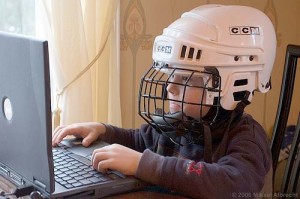 I have added a new page (see tabs above the header), on internet safety ideas for parents. Either click on the tab above or on this link Internet Safety Page
Comments/Ideas/Interesting Articles welcome!
Brain Research

A really great series on NPR recently on the teenage and middle-aged brain.
The Teenage Brain- 5 min clip
If you have or teach a teenager then the following NPR clip will interest you. Did you know that your child’s frontal lobes are not fully connected which is basically the part of the brain which says “Is this a good idea?” and “What’s the consequence of this action?” A mother of two teenage boys who also happens to be a neuroscientist explains.
Click here to listen to the podcast
The Middle Aged Brain – 30 minute clip
As a follow up, this NPR link talks about the middle aged brain. They describe middle age as 40-68 year olds!
Learning for the 21st Century- “Now Thinking” Schools
Heidi Hayes Jacob’s recent book “Curriculum 21- Essential Education for a changing World” pub. ASCD. starts with this paragraph
“What are you preparing your student’s for? 1973? 1995? Can you honestly say that your school’s curriculum and the program you use are preparing your students for 2015 or 2020? Are you even preparing them for today?”
So many schools are taking on this question with help from organizations like Partnership for 21st Century Skills and Curriculum 21 and staff who are excited about change , sadly so many are not. We as educators need to be constantly asking questions not just but the future, but the needs of our students now. You only need to visit websites of schools such as International School Bejing, to see the kind of work is being done regarding forward thinking, or as I like to call it ‘now thinking’ schools. Too many schools are locked into the 20th or even 19th century model of education. At my present school Berlin Brandenburg International School, we are working on a technology strategy which involves hiring a member of staff who is devoted to I.T Learning across the school, as well as devoting staff inservice time to try to mee the needs of our students.
When we think of 21st century learning we often think in terms of technology . Tools for learning; computers, overhead projectors, smart boards etc. These are essential, but equally as important is curriculum, the learning environment, quality assessment, key skills and of course quality teaching.
Schools that embrace Inquiry based learning strategies have the best chance of serving the needs of their students in the 21st century. Our students are entering a world with vast amounts of information at their fingertips, complex problems, technological break-throughs in a fast paced global context. They need to be equipped with the skills, not when they graduate but NOW. Inquiry based learning encourages questioning. It fosters collaboration skills. It considers multiple intelligences. It encourages students to seek the truth and discover knowledge. In essence it encourages a passion, motivation and desire for learning which continue throughout life.
Teaching these students requires a shift away from traditional 19th century techniques such as lecturing, giving facts, right/wrong answers, text book driven curricula, final summative testing and rote memorization and practice, towards student centered inquiry and direction, multiple solutions to a variety of strategies, multiple resources, practical collaborative activities and reasoning. Teachers also need to be given the tools for the 21st century as well as the training to use them. Training on how to use these tools and applications, computers, podcasts, social media applications such as Twitter and Facebook, weblogs, wikis, video, pictures and so on. Quality teachers are coaches. They guide, analyse, point, and most importantly know when to stand back. Maria Montessori once said “ The greatest sign of success for a teacher…is to be able to say The students are now working as if I did not exist” She also said “Free the child’s potential and you will transform the world”
The learning environment should not be thought of as the classroom, but rather the whole school. When you enter a school you should feel that learning is all around you, that the staff, students and visitors are all learners. I like to see open spaces being utilized in schools for learning, collaborative design, open access internet, social/learning zones, displays, in short, a buzz of excitement and a space full of energy.
Curriculum frameworks that encourage backwards design; thinking about what we want students to know and be able to do, asking guiding questions and promoting exploration and discovery will help students continue their curiosity and desire for learning throughout life. Curriculum mapping helps keep track of connections between traditional subjects in schools which offer these. Schools need to integrate technology into their curricula to enhance content and quality assessment. Assessment is simply a means to show knowledge and insight into content, skills and proficiencies. Some educators have focused too much on summative, end of unit/year tests. There is a place for summative assessments but quality teachers explore a multitude of formative options to help them and importantly their students, understand where they are. We need to replace some assessments with more relevant 21st century approaches. For example, power point presentations have become an important tool for presenting ideas and learning, but teachers can also explore film, podcasts, websites, performances, rap, song, blogs and many more tools for showing, sharing and presenting knowledge. Technology needs to be integrated across all subjects.
I have talked about quality teaching, quality environments, quality curriculums and assessment but what are the key skills which our students need to be prepared for lifelong learning in the 21st century? Partnership for 21st Century Skills talk about fusing the traditional 3 Rs (Reading, Writing and Arithmetic) with the 4 Cs (Critical thinking and problem solving, communication, collaboration and creativity). There’s no doubt that the world in 2010 is drastically different to the world even 10, 20 or 30 years ago and that the students in our schools are likely to travel more, have many more jobs and meet many more people (both real and virtual). Professor Stephen Heppell describes 21st century learners as ambitious, collaborative, reflective, embracing individuality and as having the ability to stand back and look at a global horizon. He also says “This is not the information age, it’s not the mechanical age, it’s the learning age”
So what do schools need to do if they want to change? I believe schools need to have 21st century learning central to their mission. They need quality learning environments, quality curriculum and quality teachers. Yes, the change will in some cases mean a large outlay of money. 1 to 1 lap top schemes (or even 1 to 1 ipad schemes!) cost money. Redesigning learning environments costs money and training teachers costs money, but getting excited about technology, getting excited about change, getting excited about the idea of 21st century learning costs nothing.

 Ben Kestner